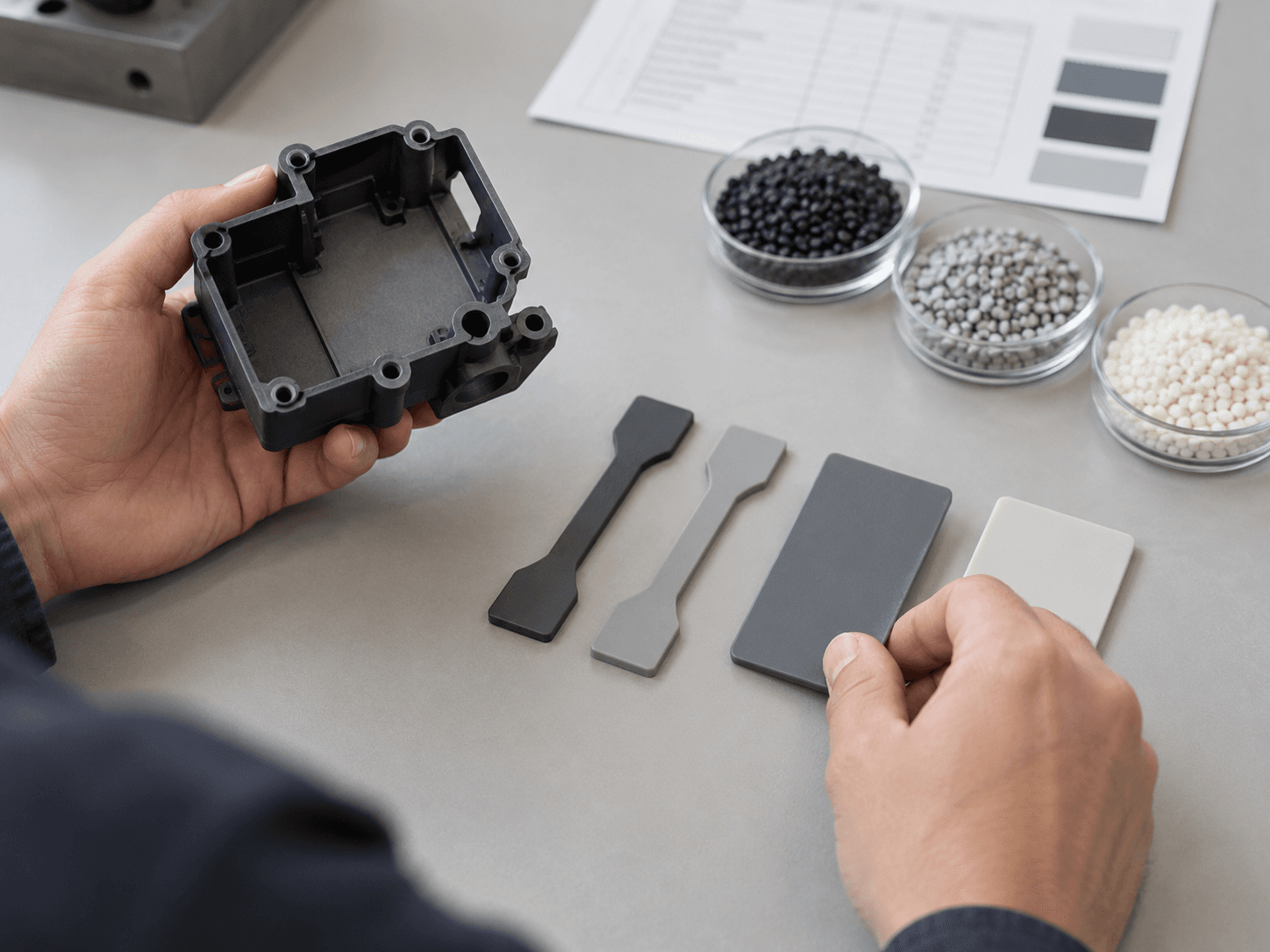
48 hours to three material recommendations. 4-6 weeksto your custom material. Built for hardware brands the majors aren't.
from your spec to three honest recommendations
from intake to your custom material in trial
than the majors' typical timeline
We pick partners based on the problem, not the order size. The part where material choice meaningfully moves your product is the conversation we want to have — and you get three honest recommendations within 48 hours.
By the time a major's sales rep schedules a first call, you have material from us in trial.
Each card below pairs a documented pain with an upside custom plastics can deliver, with precedent from teams that already captured it. Use cases span consumer electronics and robotics.
Most brands stop at 30% recycled content. Past that, color drift and surface defects show up — the product starts looking recycled.
Push past 30% recycled while keeping the surface and impact spec your design demands — a sustainability story competitors can't match yet.
Precedent: Dell + Covestro held engineering properties from 30% up to 72% recycled across three reuse cycles. Fairphone 5 ships 100%.
Robot arms and humanoids flex cables millions of times. Field data shows standard cables failing at the 18-month mark.
5× typical service life on cables that fail at the 18-month mark today. Reliability becomes a warranty claim, not a field risk.
Precedent: igus and other industrial cable engineers have validated TPU jacket formulations to 15M+ flex cycles in accelerated testing — 50% beyond the typical 10M-cycle industry spec.
AI chips in compact devices run hot. Metal heatsinks add weight, occupy space, and dictate where everything else has to go.
Engineered within a few degrees of aluminum's thermal performance at half the weight. Opens up integrating thermal management into the housing instead of bolting it on — design freedom your engineers get back.
Precedent: Sabic and Covestro both ship commercial reference grades — used in EV battery enclosures, LED housings, and premium electronics.
Industrial joints and humanoid actuators wear out their gears. Metal solves durability but adds weight; standard plastic degrades fast.
Longer gear cycle life at substantially lower weight. Formulation tuning between PEEK, CF-PEEK, and engineered POM grades depending on the cycle and temperature envelope.
Precedent: Tesla Optimus uses PEEK in the harmonic reducer rigid wheel — published 38% mass reduction and 69% lower stress on the flex spline. Aerospace has used CF-PEEK in high-cycle drives for decades.
Painting plastic parts is 15-30% of total part cost. Plus rising environmental rules on paint chemicals, plus paint chipping in the field.
Cut 15-30% of finished part cost by eliminating the paint step. Same look, no VOC compliance headache, no field chipping.
Precedent: Acer + Teijin shipped unpainted recycled-content notebooks at scale. Case studies report up to 40% paint-step cost cut.
LiDAR and stereo camera housings need micron-level precision. Standard plastic warps with temperature — enough to throw off calibration.
Sensors hold calibration through temperature, humidity, and drops. Tighter reliability story, fewer returns from miscalibration.
Precedent: Automotive ADAS pioneered this for radar and camera housings. The playbook ports cleanly to robotics LiDAR.
USB-C and similar miniaturized connectors push against how thin nylon can flow. Wall thickness and parts-per-shot both capped.
15-25% more parts per machine cycle from cycle compression on thin walls. Tooling amortization compounds — direct margin gain on every high-volume connector.
Precedent: DuPont, BASF, and Solvay all sell high-flow nylon grades for exactly this use. The differentiator is specialized polymer chemistry.
Humanoid and mobile robots need to be light to move fast, but structural parts traditionally need metal for strength.
A lighter robot moves faster and runs longer on the same battery. Speed and uptime become product features, not engineering compromises.
Precedent: Tesla Optimus uses these materials for its skeletal frame — published 10 kg lighter and 30% faster walking speed. Aerospace has used CF-PA and LGF-PA for decades in high-cycle, weight-constrained applications.
ALSO ENGAGING ON: fire-safe plastics for ultra-thin walls (EU-compliant) · EMI-shielding grade selection & integration · soft-touch rubberized surfaces · precision gear compounds · static-dissipating housings. Ask about your specific part.
Apple's “Materials Engineer — Polymers” role sits in Cupertino. Tesla's polymer choices for Optimus are made in California. In both cases, the spec is decided by the design team, not the factory.
The supplier that shows up while the design is still open gets invited into the conversation — and tends to own the part for its lifecycle. By the time a major's sales rep schedules a first call, that window has closed.
Spec intake and alternatives surfaced
Day 1-3
Three directions with honest tradeoffs
Day 3-10
Custom-make, test, refine the formulation
Day 10-28
Production-ready sample and sign-off
Day 28-42
Your single point of contact has direct access to the formulators — not a sales rep relaying questions back through layers.
Spec questions, color targets, regulatory hurdles — answered the same day you raise them, through the entire iteration phase.
Test results, formulation tweaks, and next-trial scope reviewed together every week — with new iterations launched as test data justifies them.
Once you sign off the spec, we handle ongoing supply — shipped to your OEM, warehouse, or wherever your supply chain requires.
Show us the part giving you the most material trouble — what it is, your current spec, what's broken about it. We come back in 48 hours with three material recommendations and an honest tradeoff assessment. If they hold up, we iterate with you on the actual formulation. If they don't, you've spent nothing.
Hardware brand — Consumer Electronics, robotics, or scaling startup with a real product
Pain in nylon, polycarbonate, ABS, acetal, TPU, or recycled-content plastics
Materials or product team available for 2-3 working sessions in Q3
Every application reaches the founder directly. You'll hear back within 48 hours with an initial read on your spec and pilot fit.